
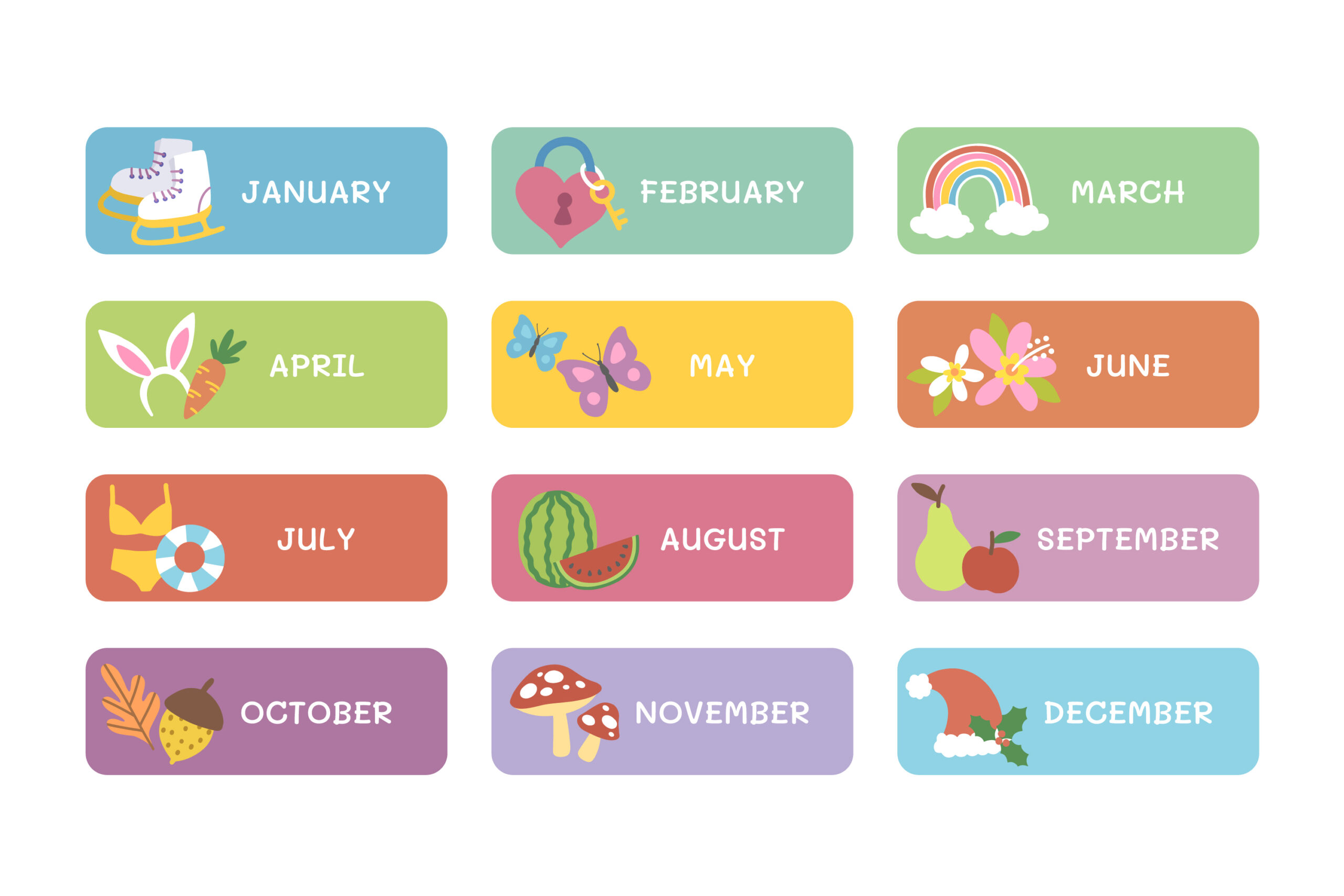
Months are an important way to divide the year and measure time. A year has 12 months, starting from January and ending with December. These months are part of the Gregorian calendar, which is the most widely used calendar in the world today.
Months help us organize our lives, track seasons, celebrate festivals, and plan school activities. Interestingly, the word “month” comes from the word “Moon,” because early humans used the Moon’s cycle to measure time.
Names of the Months
The twelve months of the year in order are:
- January
- February
- March
- April
- May
- June
- July
- August
- September
- October
- November
- December
Month Abbreviations
These months are often written in short form:
- Jan, Feb, Mar, Apr, May, Jun, Jul, Aug, Sep, Oct, Nov, Dec
These abbreviations are commonly used in calendars, schools, and official documents.
How Many Months Have 28, 29, 30, or 31 Days?
Each month has a different number of days:
Months with 31 days (7 months)
- January
- March
- May
- July
- August
- October
- December
Months with 30 days (4 months)
- April
- June
- September
- November
Month with 28 or 29 days
- February has 28 days normally
- February has 29 days in a leap year
A leap year occurs once every 4 years to keep the calendar aligned with Earth’s movement around the Sun.
Origins and Meaning of Month Names
Many month names come from Roman gods, leaders, and Latin numbers.
January
Named after Janus, the Roman god of beginnings and endings.
February
Named after Februa, a Roman purification festival.
March
Named after Mars, the Roman god of war.
April
Derived from the Latin word “aperire,” meaning “to open,” referring to blooming flowers.
May
Named after Maia, the Roman goddess of growth and fertility.
June
Named after Juno, the Roman goddess of marriage.
July
Named after Julius Caesar, a Roman leader.
August
Named after Augustus Caesar, the first Roman emperor.
September, October, November, December
These names come from Latin numbers:
- September – septem (7)
- October – octo (8)
- November – novem (9)
- December – decem (10)
These months were originally the 7th to 10th months in the early Roman calendar.
Old Names of Months
Before being renamed:
- July was called Quintilis (meaning fifth month)
- August was called Sextilis (meaning sixth month)
These were renamed to honor Julius Caesar and Augustus Caesar.
Months in Various Calendars
Different cultures have their own calendars, but many use 12 months.
Examples include:
- Gregorian calendar (used worldwide)
- Hindu calendar
- Islamic calendar
- Hebrew calendar
- Persian calendar
These calendars may have different month names and lengths.
Why Knowing the Months Name Matters for Kids
Learning the months name helps children:
- Understand time and calendar systems
- Learn about seasons and weather
- Remember festivals and important dates
- Develop planning and organizational skills
- Improve general knowledge
It also helps children build routines and understand daily life better.
Interesting Facts About Months
- There are 12 months in a year
- A year has 365 days (366 in leap year)
- February is the shortest month
- Most month names come from Roman history
- Months were originally based on Moon cycles
Conclusion
Months are an essential part of how we measure time. The 12 months of the year help us organize school, festivals, seasons, and daily life. Their names come from ancient Roman gods, leaders, and numbers, showing how history still influences our modern calendar.
Understanding months helps children learn about time, science, and the world around them.
FAQs (Frequently Asked Questions)
There are 12 months in a year.
February has the fewest days with 28 or 29 days.
February has 29 days during a leap year, which happens every 4 years.
Months were originally based on the Moon’s cycle around Earth.
The Gregorian calendar is the most widely used calendar today.